


Meet Colossal: the biotech decacorn that's bringing extinct animals back to the real world


The company was behind the birth of the first dire wolves, extinct for over 13,000 years; and this project adds to their ongoing work to bring back mammoths, the dodo, the Tasmanian tiger, and the Northern White Rhinoceros.
This Monday, it wasn’t just the stock market’s black day that captured the attention of the international press — a startup did too: Colossal Biosciences. The company was behind the birth of the first dire wolves, extinct for over 13,000 years. This project adds to their ongoing work to bring back mammoths, the dodo, the Tasmanian tiger, and the Northern White Rhinoceros. But who is behind this biotech startup? Here's a quick look at their story.
Colossal Biosciences. was founded in 2021 by George Church and Ben Lamm in Dallas, Texas. The company develops genetic engineering and reproductive technology for conservation biology and has reached decacorn status, with a current valuation of $10.2 billion.
According to a Time article, Colossal has created two spinoff companies. One, named Breaking, uses engineered microbes and enzymes to break down plastic waste. The other, Form Bio, offers AI and computational biology platforms for drug development.
DE-EXTINCTION
Follow us on: 
One of the main missions of this U.S.-based biotech is de-extinction — that is, bringing legendary creatures like the Woolly Mammoth and the dodo back to life using advanced technology.
As Colossal co-founder and CEO Ben Lamm stated in a press release: "This major milestone is the first of many examples to come that demonstrate our complete de-extinction technology is working."
He went on to detail the procedure: "Our team took DNA from a 13,000-year-old tooth and a 72,000-year-old skull and created healthy dire wolf puppies."
According to Colossal Biosciences, Romulus and Remus, the two male dire wolf pups, were born on October 1, 2024, while a female pup named Khaleesi was born on January 30, 2025.
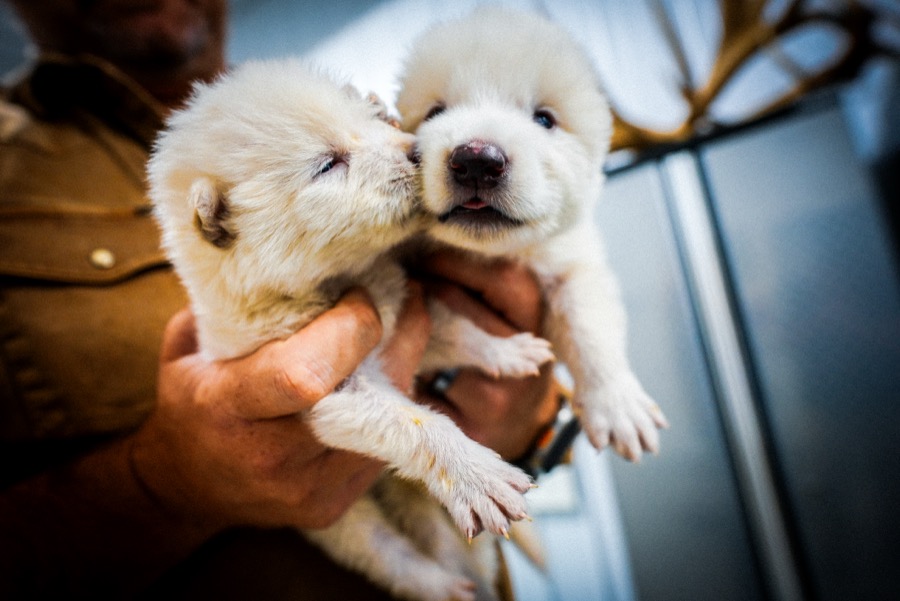
But the process was far more complex. After collecting the fossil samples, Colossal’s collaborating scientists analyzed the ancient DNA and compared it with the genomes of wolves, jackals, and foxes to identify which genetic variants were closest to those of the dire wolves — including traits like white coats and long, dense fur.
In the press release, the company stated that they used the genetic analysis to alter gray wolf cells, making 20 edits across 14 genes before cloning the most promising cell lines and transferring them to donor eggs.
"Healthy developing embryos were then transferred to surrogates for interspecies gestation," Colossal revealed in their statement, adding that three pregnancies led to the birth of the first de-extinction species.
According to Time, the surrogate mothers were domestic dogs who gave birth to Romulus, Remus, and their sister Khaleesi — the three dire wolves reborn after more than 13,000 years of extinction.
Romulus and Remus, now six months old, live on an 809-hectare site at an undisclosed location — for their own safety — where they are monitored by specialized staff, drones, and live cameras.
FUNDING ROUNDS
After its founding, in March 2022, Colossal raised $60 million in a Series A funding round led by Thomas Tull, bringing their total funding to $75 million.
In January 2023, the company closed a Series B round, raising $150 million. Then, in October 2024, Colossal announced $50 million in funding for the launch of the Colossal Foundation.
Finally, in January 2025, the company secured $200 million in Series C funding, bringing Colossal’s valuation to $10.2 billion and making it Texas’s first decacorn, according to Crunchbase. This milestone coincided with another: the creation of genetically modified mice with woolly mammoth traits — marking a major step forward in their de-extinction efforts.