


NEC and ClimateAi develop a conceptual model to promote adaptation to climate change in agriculture


The project uses AI to predict the effects of adaptation measures in the cultivation of cocoa and rice to promote sustainable agriculture.
NEC Corporation (NEC; TSE: 6701), in collaboration with ClimateAi, a San Francisco-based startup that built the first climate resilience platform, has developed a conceptual model to estimate the effectiveness of climate change adaptation measures for cocoa and rice cultivation in Africa.
In this project, ClimateAi’s long-term climate change forecasting technology, which models both the impact of climatic factors on agricultural production and the effectiveness of adaptation measures, was combined with NEC’s expertise in agricultural technology (agritech) to successfully quantify the impact of climate change on agriculture and clarify the return on investment for adaptation measures.
This achievement will be showcased at the TICAD Business Expo & Conference (Japan Fair), one of the thematic events of the Ninth Tokyo International Conference on African Development (TICAD 9) to be held in Yokohama, Japan, in August 2025, conveying the significance of utilizing digital technology to address the challenges facing African agriculture (*1).
Follow us on: 
Background and Purpose
Globally, while the reduction of greenhouse gas emissions and the trading of credits are actively taking place to mitigate the effects of climate change, the implementation of adaptation measures to prevent or reduce damage has not yet progressed. This is partly due to difficulties in evaluating the profitability of investing in such adaptation measures.
It is worth noting that, although the agricultural sector is a highly vulnerable industry to the impacts of climate, it has so far been difficult to estimate the return on investment of adaptation measures, such as the introduction of irrigation facilities or changes in crop varieties, due to the large number of factors that affect crop growth, such as temperature, water, and soil.
NEC and ClimateAi have developed a conceptual model that analyzes various factors affecting agricultural growth through the use of AI and calculates the economic return of investment of adaptation measures. The use of this model allows the implementation of adaptation measures focused on areas where positive effects are expected, thus promoting local agriculture in an efficient and sustainable manner.
General Description
This newly developed conceptual model was used to analyze adaptation measures aimed at the cultivation of cocoa and rice in various locations in Africa. The continent is the world's largest producer of cocoa, and agriculture is one of its main industries. However, due to the impacts of climate change, the cocoa and rice growing environment is expected to change significantly in the coming decades. This initiative focused on the following three adaptation measures to examine their ability to maintain and improve yields, and generate economic value in a changing climate:
- Introduction of irrigation facilities
- Switch to varieties adapted to the climate
- Change in the planting season of traditionally cultivated varieties
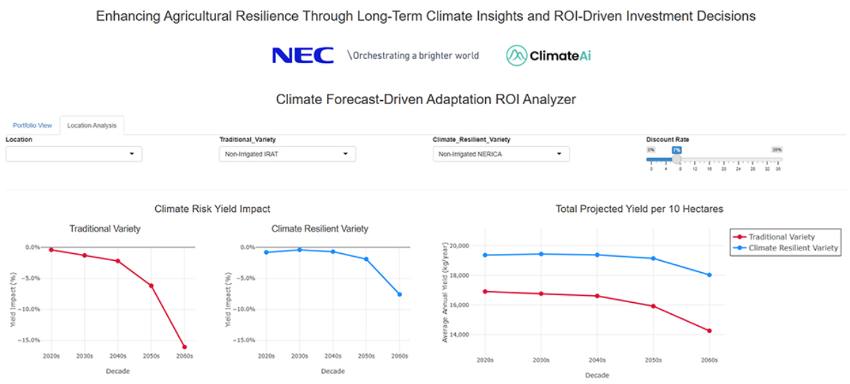
Some of the results from the analysis can be verified through interactive demonstrations. As an example of the potential applications of this conceptual model, it is anticipated that international organizations and development banks providing local agricultural support will use it to explore farmland in recipient areas and estimate the effects of implementing adaptation measures.
Beyond this example, the system is designed to meet the needs of various actors involved in agriculture, allowing them to make data-based decisions.
Results and Future Perspectives
The use of AI made it possible to analyze the profitability of adaptation measures, such as the introduction of irrigation facilities and changes in crop varieties in rice cultivation in various regions, as well as effective adaptation strategies for cocoa cultivation.
To advance in the adaptation to climate change in agriculture, significant funding is required. It has been pointed out that, in addition to the need for financial support from international organizations, development banks, and governments, it is necessary to mobilize private investment. To provide continuous financing, it is fundamental to quantify the return on investment from adaptation measures and carry out appropriate monitoring and intervention after their implementation.
While exploring collaboration opportunities with companies that provide irrigation equipment and seedlings, NEC and ClimateAi seek to leverage digital technology use cases to promote climate change adaptation financing and expand data-based agritech businesses.
Financing business for adaptation
- Support for understanding the risks in agricultural yields to reduce entry barriers for the private sector.
- Support for assessing business viability for financing.
Agritech business
- Support for agricultural producers and climate change adaptation managers.
- Support for adaptation to climate change in the initial part (seed and agricultural inputs businesses) and the final part (processing businesses, etc.) of the agricultural supply chain.
Other businesses
- Support for adaptation to climate change in the infrastructure industry and in manufacturing supply chains.
The results of this initiative were announced at the TICAD Business Expo and Conference and will be shared at other events to gather market feedback and advance discussions towards commercialization. Looking to the future, NEC and ClimateAi will work together to scientifically evaluate the impact of climate change on agriculture and present concrete solutions to achieve sustainable agriculture and food security. Both companies will continue to strive to solve global agricultural challenges through technological innovation and data usage.
The development of new businesses at NEC, under the key message "The future is ours to shape", is driving the NEC Open Innovation (*2) through diverse co-creation with a wide range of startups and partner companies. NEC's collaboration with ClimateAi is one of these initiatives. By combining innovative technologies with cross-sector collaboration, NEC continues to create new social value and shape the future.